
Fireborne Beauty

A conversation with Lithuanian ceramic artist Beatrice Keleriene
We first crossed paths through tea. On a rainy July, I attended a modern Japanese tea
ceremony at her Anagama Keramika Gallery in Vilnius, organised by Katsuhito Imaizumi— Japanese Tea Master and founder of @throughthetea and @throughthetea_stories, who
connects people through tea and ceremony*.
It was there, surrounded by her ceramics and quiet concentration, that I first encountered
Beatrice’s work: warm, tactile, ash-kissed forms that seemed to hold both silence and
movement. Later, in early September, we met again online for a longer conversation about
her journey—from graphic arts in Lithuania to wood-firing traditions in Japan, and back to her
own kilns in the Baltic countryside.

Beginnings
Lorela: Beatrice, I’d like to start at the very beginning. What first brought you to the world of
ceramics, and how did your artistic journey begin in Lithuania?
Beatrice: I studied graphic arts at an art school. My teacher, Egidijus Talmantas, spoke a lot
about ceramics. He was the one who opened my eyes to it. I realised I was more interested
in spherical shapes than in a flat image.
With clay, you can change everything—you can reshape, begin again, and the idea keeps transforming.
Lorela: That freedom must have felt quite different from drawing.
Beatrice: Yes, exactly. Later, when I was in the Netherlands, I found a book on wood firing in
a market. The ceramics inside were unlike anything I’d seen alive, unpredictable, touched by
flame. That book changed everything for me. At that time, in Lithuania, we had only local
low-temperature clays and simple wood kilns. I started experimenting with high-temperature
wood-firing—about 1,300°C—and it gave me a completely new world.

A journey through Japan
As Beatrice speaks, she often refers to her experiences abroad with quiet gratitude. Since
In 2003, she studied and practised in Japan’s legendary pottery regions: Tanba, Shigaraki,
Echizen, Tokoname, Seto, Tajimi, Hagi, Mino, and Bizen. Each, she explains, has its own
clay and rhythm of fire.
Lorela: You’ve spent a lot of time in Japan. How did that come about?
Beatrice: During a ceramics workshop in Lithuania, I met a Japanese artist. He told me he
had an anagama kiln at his studio in Japan. I asked if I could come and fire with him—he
said yes, maybe not believing I really would—but I did. That was the beginning. That
experience taught me what fire can do when it’s respected and observed closely.

The Anagama kiln and the language of flame
In 2014, Beatrice founded the Ceramic Art Centre in Dukštos area, near Vilnius, and built her
first anagama kiln—Karmazinų Anagama—modelled on the traditional Japanese type of kiln
that originated in China and Korea.
Lorela: Can you tell me more about the anagama kiln you built in Lithuania?
Beatrice: Yes. The anagama is one of the oldest types of kilns. It’s fired for five days and
nights—around 115 hours—burning pinewood and reaching 1,300 °C. The ash from the
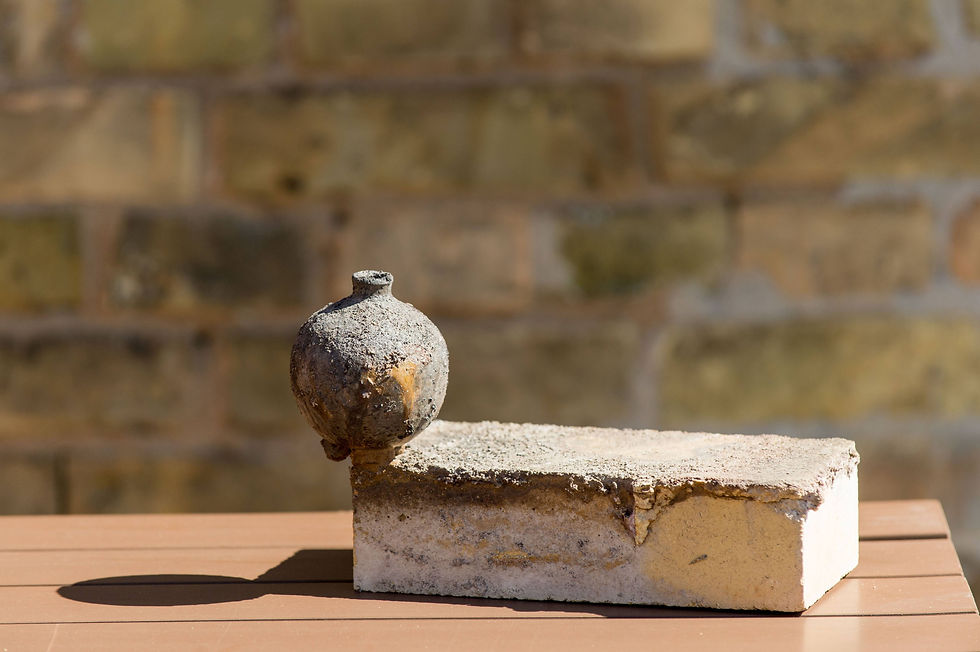
wood melts in the heat and creates a natural glaze on the surface of the clay. The flames
themselves paint the ceramics.
I always say that in an anagama, you collaborate with the fire. You can plan where the ashes will fall and where the flame will touch, but in the end, the kiln always gives you something unexpected.
She smiles. “It’s alive. You never really control it—you just guide it.” Her latest anagama kiln, Dukštos Anagama, continues this practice, along with her old Vilnius-based shorter wood-fired kiln firings. That old one, the Olsen style kiln, takes just twelve hours to fire and allows work on more rapid experiments with mixtures of wood ash, ground stone, and various clays to achieve different tones and glosses.
Clay and landscape
Lorela: What kind of clay do you work with today? Do you use Lithuanian clay, or do you
import it?
Beatrice: I usually use German clay as the base in my mixtures. I mix two or three
types—white and red, high-temperature clays. When possible, I add a little wild clay, about
20%. It changes the surface—it feels more ancient, more alive. In Japan, you can dig clay
straight from the mountain and use it after cleaning. But in Lithuania, we don’t have
mountains, so our clays are terracotta, low temperature. Our geology is different.
Lorela: That’s fascinating—so the geography itself defines the work.
Beatrice: Exactly. In Japan, every region has its own distinct identity due to its unique clay. In Bizen, Shigaraki, and Tokoname, the earth, the firing, and the kiln are all connected. You can’t copy one without the other.
Tea and the shape of ritual
Our conversation naturally turns to tea—the quiet link that first connected us.
Lorela: Since we met through a tea ceremony, I’d like to ask: what’s your personal
connection to tea?
Beatrice: When I was young, thirty years ago, we drank tea in a very different way. We had
big teapots, big cups—family gatherings, friends visiting. Mostly black tea, Indian or Chinese.
Later, in Japan, I discovered sencha, matcha, and all these refined teas—but for me, the real
fascination was in the vessels, not the tea itself.
Lorela: So you came to tea through ceramics, not the other way around.
Beatrice: Yes. Many people discover ceramics because they love tea.
I discovered tea because I loved ceramics.
In Japan, every form has meaning—a bowl for rice, a bowl for tea, each with rules and proportions. The vessel teaches the hand how to drink.

Challenges and rhythm
Lorela: What are the greatest challenges in your practice?
Beatrice: Unlike the more popular firing of ceramics in electric kilns, where firing is simply the
completion and fixation of the creative process, in a wood-fired kiln, this is perhaps the most
complex part of the creative process. Preparing the wood, loading the kiln— an incredible
amount of time and hard work put into it. When I was younger, I fired three times a year. Now
only once or twice. Wood is expensive, and I prefer to go slowly and make something better.
Maybe it's also accumulated experience?
She pauses, thinking. “In Japan, I met people who fired their anagama only once every two
years. I thought it was strange—but now I understand. You need time to prepare and to
think. The fire is not only a process; it’s a rhythm.”

Teaching and timelessness
Lorela: You also teach ceramics. What do you try to pass on to your students?
Beatrice: I tell them: Don’t work quickly. Think carefully. Make something that will still look
beautiful after ten years. Trends change so fast, but simple, calm ceramics can remain
beautiful for hundreds of years. Time doesn’t matter for good things.
The Vilnius Tea Festival and the “secret collection”
Lorela: You’ll be attending the Vilnius Tea Festival soon. What will you be presenting there?
Beatrice: I’ll bring my secret collection—pieces I’ve kept from each firing, my favourites from
the last ten years. Each one is a small story of the kiln.
If I sell them, it’s important who buys them. I want them to go to people who understand what they’re holding.

Looking ahead
Lorela: What are your dreams for the next few years?
Beatrice: I want to make larger works for exhibitions. Maybe join artist residencies
abroad—in Shigaraki, Arita, or even the United States. I think I’m ready now. I waited to
grow, and now I want to travel, to meet other artists, new kilns, and new clays.She smiles again, a small, serene smile.
“It’s always the same journey,” she says. “Clay, fire, patience and a little bit of mystery.”
Notes
In 2014, Beatrice founded the Anagama Ceramic Art Centre in Dūkštos, set up special
places for ceramicists to practice, and now the second one, Dūkštos Anagama, is still
burning pine wood. Her Anagama Keramika Gallery in Vilnius (Juratės 1, near Sapieha
Palace and TechPark) welcomes visitors by appointment and offers pottery workshops and
exhibitions. Her Anagama and wood-fired ash-glaze works are known for their natural
surfaces, durability, and silent strength—each one touched by the fire’s own hand.
Connected interview available below:
Through the Tea: Katsuhito’s Journey of Taste, Heart, and Heritage


Comments