
Between Memory, Tea Fermentation and Gastronomy: BRON

A Conversation with Natalie Schrauwen of BRON Kombucha

Introduction
Some people taste a drink, and there are people who seem to build an entire landscape around what they taste.
I met Natalie Schrauwen during an open-house tasting at BRON's microbrewery in Antwerp. What was supposed to be a conversation about fermented tea quickly moved between white peaches, perfume, wild plants, Japanese green tea, Malawi, fermentation, gastronomy, entrepreneurship and the future of alcohol-free drinking.
It makes sense, because Natalie herself is difficult to place into a single professional category. She is the founder and flavourist behind BRON, but also a researcher, teacher, consultant and producer. At one point during our conversation, she described herself as a "dramaturge with food" and, with a smile, "a little bit of a witch."
BRON itself sits at a similar intersection. Its beverages begin with an adapted kombucha culture and high-quality tea before being constructed with herbs, plants and spices. But Natalie isn't trying to make another kombucha or soft drink. BRON was conceived for the gastronomic table: with acidity, bitterness, tannin, aroma and length considered much as they would be in a kitchen or wine pairing. Since its beginnings, the brewery has developed alcohol-free pairings for restaurants including 't Zilte, The Jane, Boury, Dôme and Dim Dining.
Our conversation explored the person behind those flavours: how Natalie trains her palate, how memories become ingredients, her own relationship with Camellia sinensis, the realities of creating beverages for gastronomy and what it actually takes to build a small beverage company in Belgium.

1. BRON has become known for botanical fermented beverages and gastronomic pairings, but every business starts somewhere. Can you take us back to the beginning? How did your fascination with flavour and fermentation evolve into BRON, and what made you decide to turn it into a business?
My work has always existed somewhere between science, working with my hands and intuition, in a very close connection to nature and the senses. Through ELDER Lab, I teach about wild plants, fermentation, taste and smell, and BRON became a way of translating that knowledge into beverages.
From the beginning, BRON was developed to be at the table. We weren't interested in making simply another soft drink. The idea was to create something alcohol-free that could have depth, acidity, botanical complexity and the kind of mouthfeel you might normally associate with wine or cider.
Working with gastronomy became important very early. We started creating seasonal alcohol-free pairings for restaurants, and that immediately changed the way you have to think about a beverage. It has to work next to food.
We started offering fermentation masterclasses quite early on, and many of the participants were chefs and sous-chefs who wanted to learn how to incorporate fermentation into their own kitchens. For every class, we prepared different samples and experiments to taste and explore together.
Eventually, chefs from The Jane, Dôme and a few other restaurants started asking whether we could produce some of these fermented drinks for them. We said yes, and that's really how BRON was born. It wasn't something I had planned from the beginning—the company emerged almost accidentally from the masterclasses and the demand that grew around them.
2. You have an extraordinary relationship with smell, taste and sensory memory. How do you train your palate, and how do personal memories become part of the way you understand and create flavour?
For me, flavour is very strongly connected to emotion.
The simplest example is when my daughter was born. It was May, the weather was becoming really warm, and I was eating a lot of white peaches. She was this tiny baby with furry cheeks, and I was incredibly happy.
Now, when I smell white peach, I melt. I can almost shed tears of joy because it immediately brings me back to my daughter and to that feeling of how much I love her.
Other flavours bring me somewhere completely different. Tarragon reminds me of being eighteen, spending endless summers in the South of France with friends and playing pétanque under the trees with the old guys.
That's how I remember taste, and I've really trained that.
I smell everywhere. I'm the weird person in the shop touching and smelling everything. I do it in nature too. Even when I meet people, I notice smells—the washing powder, perfume, their skin in summer or winter.
You gradually build this enormous internal memory of smells and flavours. It is like reading novels while you are walking around, nose in the wind, all these emotions rolling in.
3. You told me that you're not interested only in beautiful or pleasant flavours—that we should also experience bitterness, fermentation, decay and even disagreeable smells. How does this philosophy influence the way you construct a drink?
People often think that when you're working with taste and aroma, you should choose the nice things. I really disagree. You should smell everything—including disagreeable things. For me, it's about embracing the world in both its darkness and its lightness. That's how you make interesting things.
We put "dirty" things into compositions too. It's similar to perfume. We are living organisms, and eventually we disappear.
There is something about that impermanence that should be allowed into what we drink and eat.
Fermentation is very connected to that for me.
Taste also develops when you expose yourself to things that aren't immediately comfortable. Bitterness is a good example. We don't experience enough bitterness anymore because so much of what we consume is sweet.
But bitterness can create extraordinary flavour profiles. It is a touch of danger and tension.
If you're curious about flavour, you can't only taste what you already know you like.
Life is not only sunshine, butterflies and ponies; what we eat and drink should be a little bit of a reflection of that.

4. You describe yourself as much more than a beverage producer: a researcher, teacher, consultant, producer and even a "dramaturge with food." How did this multidisciplinary profession evolve, and why is it important for you to bridge science and intuition rather than choose between them?
It's difficult for me to define because I'm not one thing.
I'm a researcher. I'm a dramaturge with food. I'm a teacher, a consultant and a producer. And I'm also a little bit of a shaman—or a witch. I think it's nice not to have to be one thing.
I also don't want to have to say, "I'm on the scientific side," or, "I'm on the intuitive side."
I like building bridges between worlds that don't seem to match.
That is probably what connects everything I do. There is a technical and scientific side to fermentation and production, but creating flavour is also intuitive. I don't see why those two things should have to exist separately.

5. BRON focuses strongly on botanicals, but Camellia sinensis remains part of your work and personal life. What teas do you personally love drinking, and what do you look for when working with tea?
When I'm working, I really like fukamushi (Japanese Sencha - green tea deeply steamed). It makes me concentrated, focused and happy. I love that grassy flavour.
I'm a marine person—I love the sea—and good Japanese green teas make me think of the sea. There's something about them that makes me really happy. We drink quite a lot of genmaicha here too, particularly in early spring and autumn.
I also really like oolongs, although that's an enormous category. White tea is something I learned to appreciate more deeply later. The flavour was always beautiful, but visiting my first tea plantation in Malawi changed something for me. When you're walking between the bushes, you smell the flowers and the leaves, and then you recognise those aromas in the white tea. Suddenly, drinking it takes you back to walking between those plants.
With black teas, I particularly enjoy some African teas. They can have this honey-like quality, sometimes with an orangey, silky undertone.
But green tea still gives me a feeling that seems made for me.
I also make a lot of cold infusions. Sometimes after we've used tea for a production batch, I'll put the leaves into cold water in the fridge and drink that infusion afterwards.
When it comes to sourcing professionally, relationships matter enormously. I believe you should choose specialists and then trust them. If you've selected a producer because they're good at what they do, you have to allow them to bring that expertise.
I believe strongly in long-term relationships. That's how you make better products.
I met Wouter from Satemwa in a meeting, but was really struck by the quality of the teas and the passion and the social and technical innovation that they have for their craft. I visited the plantation and fell in love with the place, the owners and their teas. All drinks we make are based on one of their teas.
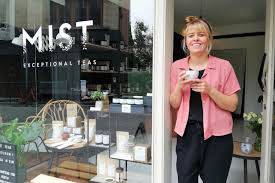
Dorien from MIST Teas later asked us to make a kombucha with one of their Taiwanese teas. After some testing, the roasted oolong was so amazing that we still make this fermented tea and use it as a second-layer tea in a lot of our autumn selections.
6. BRON has worked closely with gastronomy, including restaurants such as The Jane and Boury. When creating a drink for a chef or restaurant, how do you translate their identity, cuisine and customer into flavour?
When somebody comes to us for flavour development, I first look at them and try to make an assessment: Who are you? Who is your client? What is your tone of voice on a plate?
Then something comes. We create parameter tests, they taste the first version, we receive feedback, and then we create a second version. It can actually happen quite quickly.
Working with restaurants also shaped how we produce from the beginning. Because we were working with top chefs, there had to be a certain level of consistency. Our recipes are extremely precisely measured.
But the drink also has to work with food.
You need to think about acidity, bitterness, sweetness, saltiness, tannin, aroma and length. What happens next to fat? What does acidity do with umami? Does an aroma disappear when you put it next to smoke or spices?
A drink in gastronomy isn't isolated. It has a role within the entire experience.
That's probably also why I like the expression dramaturge with food. You're creating something that needs to function within somebody else's story.

7. Fermentation and natural ingredients are inherently variable, yet fine dining demands precision. How do you achieve consistency between batches while still allowing seasonality and living ingredients to express themselves?
There are two sides to this. As I mentioned, because we worked with top chefs from the beginning, our recipes had to be very precise. But I also adapt according to taste.
Nothing goes out before I taste it. We don't work only with measurements; we also include an organoleptic evaluation. I have a very good memory of what a particular product should taste like, so I can make adjustments.
At the same time, from the beginning I've explained that we're working with natural products.
There will always be variation. The flavour can be different in summer compared with winter.
Ingredients change. I can adapt, but I don't want to pursue the kind of absolute consistency expected from an industrial soda.
The objective is consistent enough while still allowing the ingredients to be what they are.
We also have two different lines. One is pasteurised and shelf-stable for around two years. That's particularly suited to the wine and gastronomic market as a non-alcoholic alternative.
Then we have the living products, which change much more with the seasons. They serve different purposes.

8. If someone came to you today wanting to create a kombucha or fermented beverage brand, what would you tell them?
Think about your story.
And I don't mean "story" as marketing. It needs to be something you genuinely believe yourself.
There are already many people on the market, and I think authenticity is what really touches people. That's what gives something the longest life.
Then: choose your partners well. I delegate quite a lot of decisions to the people I work with. You select a producer, and then you trust them.
Work with specialists if you want to make good things. Choose those specialists carefully, stick with them and think long term. I really believe in good long-term relationships. That's what ultimately creates the best product.
There is also a very practical side that people shouldn't underestimate. Fermented beverages involve a lot of traceability and administration, and people can still be nervous about fermentation.
That means you have to be efficient. There are many beautiful ingredients I taste and would love to work with, but a product also has to be operationally feasible.

9. There is a romantic image around craft beverages, but behind them is a business. Is it possible to build a sustainable living from a small beverage business in Belgium?
It's not something you're going to get rich from. If you want to get rich, it's probably better to work for a big company.
But I still believe in growing.
What we do comes from the heart first. At the same time, economically, the last few years have been hard. COVID was difficult, and I think the climate for small companies in Belgium isn't particularly gentle. Small companies are often the ones inventing things, but surviving is difficult.
Another problem has been unpredictability.
Product costs, gas, glass, metal—everything has gone up and down. It's incredibly difficult to make budgets when costs behave like that. Sometimes you simply have to make something and then work out afterwards how to deal with what happened.
And consumers have changed too. The hedonistic budgets aren't really there at the moment. People still treat themselves, but perhaps not in the way they did before.
That's difficult for restaurants, but also for producers like us. So yes, you can build something, and I still believe strongly in growth. But people shouldn't underestimate how difficult the business behind a craft beverage can be.
10. You are developing new flavours for other businesses, exploring tea-based beverages and considering ideas such as concentrated kombucha. At the same time, you work as a consultant with alcoholic beverage companies. Where do you see BRON—and gastronomic alcohol-free beverages more broadly—going next?
The movement towards drinking less alcohol will definitely continue.
I work as a consultant for alcoholic companies too, and they really feel it coming. People are changing their relationship with alcohol, and we know increasingly more about its effects on the body. I think that's going to continue influencing the market.
For BRON, there are several directions I'm interested in.
We're developing new flavours for other people. There's a new flavour coming for Boury, and we're developing five flavours for a project in the Netherlands. Those will be really tea-based and designed for the wine market.
I'm also very interested in kombucha concentrates.
We're transporting enormous amounts of water. Why do that? I'd like to develop really good tea-based concentrated kombucha that can be diluted closer to where it's consumed.
And I would like to explore the health side more, particularly returning to some of the ways tea was traditionally used.
We live in a society that is constantly demanding our attention. Even without talking about clinical ADHD, our way of living creates a kind of permanent distraction.
I think tea can be one hell of a medicine for that. Tea gives me focus. That's one of the reasons I love drinking Japanese green tea when I'm working.
So for me, the future isn't simply about replacing wine with something alcohol-free. There is much more to explore around tea, fermentation, botanicals, gastronomy and how these drinks make us feel.
Conclusion
What stayed with me most after talking with Natalie wasn't a particular BRON bottle or ingredient. It was her way of thinking about memory.
White peach isn't simply an aroma. It can be May, warm weather and holding your newborn daughter. White tea can become walking between tea bushes in Malawi. Fukamushi can become the sea.
This made me think about what it actually means to have a trained palate. We often associate expertise with being able to recognise flavours and give them names. But perhaps sensory expertise is also about accumulating an enormous internal library of smells, tastes, textures, places and emotions—and learning how to retrieve and combine them.
That philosophy is visible in BRON itself.
The drinks occupy an interesting space between tea, botanical fermentation and gastronomy. They aren't trying to reproduce wine, nor do they fit comfortably into the conventional idea of kombucha. Instead, Natalie approaches a beverage almost as a chef approaches a dish: constructing acidity, bitterness, tannin, aroma, texture and length, while leaving enough space for natural ingredients and fermentation to remain alive.
And behind all of that creativity lies another story that I find equally important to tell: building a craft beverage company is difficult.
Ingredients fluctuate. Production needs to scale. Restaurants have tighter budgets. Natural products resist perfect standardisation. And the economics of being a small producer in Belgium are far removed from the romantic image we sometimes associate with craft food and beverages.
Perhaps that is why Natalie's refusal to define herself through one profession feels particularly appropriate.
Researcher. Teacher. Consultant. Producer. Flavourist. Dramaturge. And, occasionally, a little bit of a witch. All of those roles seem necessary to build something like BRON.
Credit Picture: Natalie Schrauwen


Comments