
Beyond the Tea Brand: Building Experiences, Partnerships and a Profitable Tea Service-Business

An Interview with John Wilken, Founder of “John Wilken's Time For Tea”

Introduction
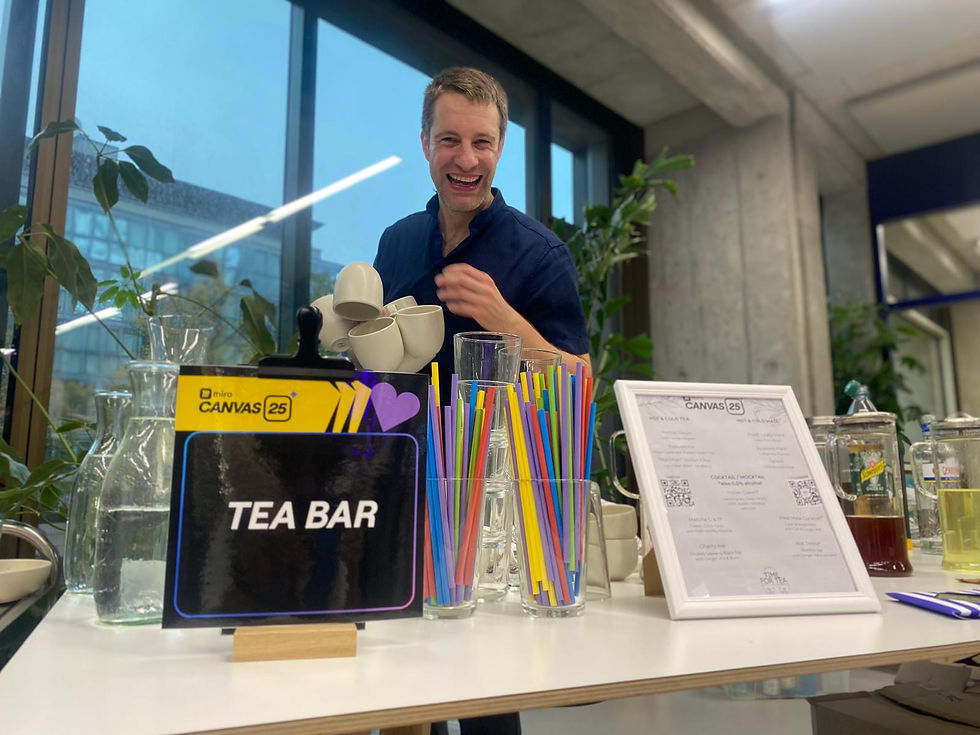
I first met John Wilken at the Berlin Tea Festival in 2023, when he was leaving his sales position at Paper & Tea. We crossed paths again in 2024 during a Tea & Cocktail event hosted in a Berlin coworking space, where I had the opportunity to see his approach in action: accessible, interactive and focused on giving people an experience rather than simply serving them a beverage.
When we met again in 2025, I was pleased to see how much his own venture, “John Wilken's Time For Tea”, had evolved. What had initially emerged from a few requests by former clients was developing into a broader portfolio of corporate workshops, team-building formats and tea-led experiences delivered through a growing network of facilitators.

John’s career is particularly interesting because he did not follow the most obvious path into tea entrepreneurship. He did not launch a tea brand or open a shop. Instead, he built a service business around tea, applying his experience in sales and business development to an industry that often places craftsmanship and product knowledge far ahead of commercial strategy.
In this interview, we explore his personal journey into tea, the lessons he learned from working across hospitality, retail and corporate sales, and the development of “John Wilken's Time For Tea”. We also discuss pricing, partnerships and why tea entrepreneurs should not be afraid to think about scalability, profitability and sales.
Lorela: Before building a career in sales—and eventually founding “John Wilken's Time For Tea”—there was your own relationship with tea. How did tea first become part of your life?
John: Looking back, I only realised later that tea had been part of my life for a very long time.
When I came home from high school, my mother was normally at home because she worked part-time. She would make some black tea, which I usually drank with milk and sugar, and we would sit together for around ten minutes and talk about our day.
At the time, I did not recognise it as a special ritual. In hindsight, however, I think that was when tea became connected in my mind with quietness, relaxation and spending time with another person.
I continued drinking tea throughout my life. I was never particularly interested in coffee because I am very sensitive to caffeine. Coffee can make my heart race and leave me feeling as though I need to move physically, whereas tea helps me concentrate without making me hyperactive. It is something I can drink throughout the day.
Of course, I also drank plenty of very bad tea because I did not yet understand what quality tea could be.
The relationship became more serious while I was living in Sweden and co-founded a company in the beverage sector. I started becoming curious about what tea actually does to the body. I wondered why Zen Buddhists drink matcha before meditation and why the effects of tea felt so different from coffee. Tea gradually became a serious hobby, and I began thinking more carefully about what I was drinking and putting into my body.
Later, after moving to Berlin, I walked into a Paper & Tea shop. I remember thinking that I had never seen a tea store that felt so open or made tea so approachable. Someone offered me a cup, and the entire experience felt completely different from the traditional tea shops I had previously encountered.
I applied for a job there the following day.
It was not a carefully planned career move. It happened somewhat by accident, but that was the beginning of my professional engagement with tea.
Lorela: You were responsible for hospitality, retail and corporate sales at Paper & Tea. How did that experience shape your understanding of the speciality tea market?
John: When I joined Paper & Tea, the company was still considerably smaller than it is today. As Head of Sales, I was initially responsible for three areas: hospitality, retail and corporate sales.
What became clear very quickly was that each of these markets was looking for something completely different.
Hospitality clients care about taste, product quality, storytelling and the wider concept. They want something they can use to impress their guests and improve the overall experience.
Retail buyers also want a good product, but presentation becomes extremely important. The packaging has to attract attention immediately, and margins matter much more. In hospitality, whether a cup costs fifteen or twenty cents may not significantly affect the business. In retail, earning one euro more or less per package can make a significant difference.
Corporate sales are different again because the client is often difficult to define. The person purchasing the workshop or experience is not usually the person participating in it. You may be speaking to an office manager or HR manager, but the final audience consists of employees who may know almost nothing about tea.
You therefore have to communicate on several levels. The person organising the event wants to understand what you can offer, why the process will be easy to manage and why their colleagues will enjoy it. Once you arrive at the event, you then have to engage an entirely different group of people, many of whom may not even know what is about to happen.

That taught me to listen carefully and adapt the offer to the person in front of me. You cannot simply repeat the same sales message to every customer.
It also showed me how little most people know about tea. People often believe they understand coffee or wine, especially in a city such as Berlin, but tea is different. Almost everyone has a point of contact with tea, even if they only drink it when they are ill, but very few have experienced what good tea can be.
Most people simply drink what their parents drank or continue buying the same product from the supermarket. When you introduce them to a completely different world of tea, the response can be very powerful.
I do not want to speak down to people or overwhelm them with information. The tea industry can sometimes be very good at talking to consumers from above. I prefer to meet people at their own level, take them by the hand and show them something they have never experienced before.
Some of my favourite participants are those who begin by saying, “I do not really care about tea; I only drink it when I am sick.” They are often the people who approach me afterwards and say they had no idea tea could be so complex.
Opening that door for someone gives me a great deal of joy.
Lorela: Most tea entrepreneurs begin with a product, whereas you have built a business around services and experiences. How did “John Wilken's Time For Tea” come about?
John: As often happens in life, it began through coincidence rather than a detailed business plan.
After leaving Paper & Tea, I took some time off to be with my family and my newborn son. During that period, a former client contacted me. They had previously organised a tea workshop through Paper & Tea and wanted to arrange another one, but the company no longer offered that service.
They asked whether I knew somebody who could do it.
I said that I did not, but asked what they had in mind and offered to host it myself. I knew the client quite well, so initially I saw it partly as a favour. They wanted a guided tasting of teas that people would probably not know, accompanied by an introduction to the wider world of tea. They also told me they would pay me. I had not even thought about that at first.
I hosted the workshop, enjoyed the experience and thought that was probably the end of it. A few weeks later, however, another former client contacted me with almost the same request.
Receiving the same enquiry twice within one or two months made me think there might be a real opportunity. I had already developed the basic concept, so I started presenting it to people in my network, mainly through LinkedIn, to see whether others would respond.
The response was positive, and suddenly I had several workshops lined up.
I also realised that I could not offer the same customer an identical experience every year. That encouraged me to develop additional formats. What began with one tasting gradually became a portfolio of workshops related to tea.
At that stage, I still considered it a potentially interesting side business. It would allow me to meet people, work flexibly and remain available for my family. It grew step by step rather than overnight.
Then my wife asked me a very simple but important question: “Does it need to be you who hosts every workshop?”
Until that moment, I had never properly considered it. I was also the limiting factor in the business. I did not want to spend five evenings every week delivering workshops, particularly when part of the purpose was to create more flexibility around family life.
I began approaching people I knew who had strong tea knowledge and, equally importantly, the right personality. I asked whether they would be interested in delivering some of the experiences with me.
That allowed “John Wilken's Time For Tea” to expand beyond Berlin. We now work with people in cities including Hamburg, Munich and Vienna, and we have been developing the UK through a country partnership.
The formats need to be transferable, but I do not want every facilitator to repeat a script word for word. They are professionals with their own interests and areas of knowledge. I want them to speak about the subjects that genuinely excite them because that enthusiasm is what participants respond to.
Lorela: You have developed formats ranging from matcha and tea cocktails to The Brew Battle. What makes a corporate tea experience memorable?
John: What I offer is an experience that, in most cases, people have never had before.
Anyone who has worked in a corporate environment has probably attended many team events. Some are enjoyable and others less so, but most are quickly forgotten. People may have had pizza and drinks together, but they are unlikely to remember the catering several years later.
They tend to remember doing something unusual: a graffiti workshop, a pottery class or another activity they would probably never have organised independently.
Tea can provide that type of experience.
I do not want to stand in front of a group and speak for an hour while everyone listens passively. I want participants to do something themselves. During a matcha workshop, they whisk their own matcha. During a cocktail or mocktail session, they create the drinks themselves.
If I simply handed people prepared tea cocktails, I would be operating as a catering company. When participants prepare the drinks, they gain a sense of involvement and pride because they have made something that did not exist before.
We all know that something often tastes better when we have made it ourselves. Someone who prepares their own matcha gin and tonic—particularly if they have never whisked matcha before—is much more likely to remember the experience.
Tea is also a very tangible and emotional product. This can be particularly valuable for technology and software companies, where employees spend much of their working lives creating digital products.
With tea, they can touch the leaves, smell them, watch the colour change, taste the result and share it with the people around them. It provides a physical counterpoint to an increasingly digital working environment.
The experience can also show people how widely tea can be used. Participants may discover cold brewing, tea cocktails, mocktails or tea-infused chocolate. They leave not only having tasted something new but also with ideas they can recreate at home.
One of my mentors later asked me what would have to happen for a client to happily pay three times more for one of my workshops.
That question led me to create The Brew Battle. It is a three-hour team-building format in which participants develop their own tea blend, use artificial intelligence to help construct a brand, create a sales and marketing strategy and pitch their concept against the other teams.
Tea is still central, but I am not primarily teaching people about tea. It becomes the product through which they practise creativity, teamwork, branding and communication.
A three-hour team-building workshop creates a different level of value from a one-hour tasting, and it can be priced accordingly. The lesson was not simply to charge more for the same service, but to create something substantially more valuable.
Lorela: Partnerships have played an important role in expanding “John Wilken's Time For Tea”. What makes a partnership commercially successful?
John: This is something I am still learning every day: when to say yes and when to say no.
It is particularly difficult when you are self-employed. When somebody offers a potential opportunity or promises that money may come at some point, your first instinct is often to accept. Bills still need to be paid.
What I have learned, however, is that both parties need to be able to explain what they expect from the relationship.
This applies whether it is a genuine collaboration in which both sides contribute resources, or a more traditional client and service-provider relationship. If the other party cannot articulate what they hope to achieve, that is a warning sign.
For example, somebody may ask me to generate sales for their company. My first question would be what they believe is a reasonable outcome after three or six months. When the answer is simply, “I do not know; let us see,” disappointment becomes very likely. Even a strong result may not be enough because their expectations were never defined.
The same applies to an event. Does the client want guests to be surprised? Do they want something experimental, or simply a flawless activity that works for everybody? When the organiser cannot explain the objective and tells you to do whatever you want, they may still find something to dislike afterwards.
Expectations therefore need to be verbalised and preferably written down by both sides.
This is even more important when working with a larger partner. A startup may see a collaboration with a big company as a major opportunity because of its visibility and reach. But when the larger company is not equally committed, the smaller partner can end up doing all the work and receiving very little in return.
It is difficult to reject the promise of a valuable collaboration, particularly when you are still building the business. Sometimes, however, saying no is necessary.
I would rather develop partnerships in which the objective, contribution and potential value are clear for everyone involved.

Lorela: Many tea entrepreneurs are highly knowledgeable about the product but uncomfortable with sales. What advice would you give them?
John: The tea industry attracts people who are deeply passionate about tea. We can become very knowledgeable about origins, processing, preparation and flavour, but sales is often one of the last subjects entrepreneurs want to address.
There is sometimes an assumption that selling means manipulating people or pushing them to purchase something they do not need. I do not see it that way.
When you genuinely believe that your product or experience can bring someone pleasure, offer them something valuable or introduce them to a new world, selling is a way of helping the right person discover it.
A wonderful product cannot have an impact when nobody knows it exists.
Tea entrepreneurs also need to understand the person they are selling to. It is not enough to explain why tea is special from your own perspective. You have to ask what matters to the customer. A restaurant, retailer, corporate client and individual consumer will not evaluate the same product in the same way. The story may be important to one person, while margin, convenience, appearance or customer experience may matter more to someone else.
You do not need to abandon the values behind your product. You need to communicate those values in a way that connects with the person making the decision.
I also believe entrepreneurs should avoid starting with prices that are too low.
Small businesses often assume that they must be cheaper than established companies. In reality, an entrepreneur frequently creates a unique product or experience for a specific occasion. Large providers may deliver a standardised format that has been repeated a thousand times, while the entrepreneur is adapting the work to the individual client.
That personalisation has value.
An agency once suggested working with me partly because I was not one of the established providers charging significant prices. They assumed that, as a smaller company, I should naturally be cheaper. That is not necessarily true.
You still have to remain realistic and understand what the market will accept, but you should not automatically undervalue your work. If a company is willing to pay a very high amount for basic catering, there is no reason a distinctive tea experience—such as live matcha cocktails or a tailored workshop—should be valued below a plate of standard sandwiches.
The more unique and relevant the service is, the more confidently it can be priced.
Lorela: Have you noticed a change in the way companies perceive tea in relation to employee wellbeing and workplace culture?
John:
Two developments are particularly positive for tea: the wider health trend and the fact that tea can be inclusive.
People are thinking much more carefully about health, wellbeing and longevity. Companies are also increasingly interested in activities that support employee wellbeing rather than simply providing another conventional social event.
Tea fits naturally into that space.
It is also possible to create experiences that include almost everybody. Participants may drink traditional tea, herbal infusions, matcha, cocktails or alcohol-free mocktails. Someone who avoids alcohol or wants less caffeine does not have to feel excluded from the activity.
That flexibility is important in modern workplaces, where teams include people with a wide range of preferences and cultural backgrounds.
Tea can also create connections.
During workshops, I sometimes see a participant who has just learned how to whisk matcha begin showing the next person what to do. At that point, the activity is no longer simply being delivered by me. People are interacting and building the experience together.
This is particularly relevant now because our lives are highly connected technologically, while people can still feel very isolated personally. Companies recognise that employees need opportunities to meet and connect offline.
Tea is a gentle way of creating that environment. It gives people a reason to pause, use their senses, make something together and have a conversation.
The current matcha boom is also creating a significant opportunity for the wider tea industry. Matcha can serve as a gateway for people who might otherwise never have explored tea.
At the same time, it presents a risk. When every low-cost bakery begins serving a poorly prepared matcha latte made from low-quality powder and large amounts of sugar, the experience can damage the perception of the product.
Charging a premium price for a bad matcha may persuade consumers that the category is not worth exploring.
The opportunity therefore comes with responsibility. If matcha is someone’s first meaningful encounter with tea, quality matters. A positive experience can lead them towards many other types of tea; a negative one may close the door immediately.
Lorela: What advice would you give someone trying to build a sustainable tea business today?
John: Begin with a good product or service, but do not wait indefinitely for it to become perfect.
Entrepreneurs can spend a great deal of time refining an idea internally. Friends and family may say that it is wonderful, but that is not meaningful market validation. The important moment is when somebody who does not know you is prepared to pay for what you have created.
Develop a minimum viable product, put it in front of real customers and listen carefully to their response. What do they understand immediately? What confuses them? What are they actually prepared to pay for? Which element do they value most?
That feedback is more useful than attempting to predict every detail in advance.
You also need to be willing to adapt. Entrepreneurs can become attached to their original idea, but the purpose of the business is not to protect that idea at all costs. It is to create something customers genuinely need or want. Finally, learn to sell.
You can have exceptional tea, beautiful packaging and enormous knowledge, but none of that will create a sustainable business unless you can reach customers and communicate the value of what you offer.
Sales should not be treated as the final stage after the product, branding and website have been perfected. It needs to be part of the business from the beginning.
The tea world contains many excellent concepts and talented people, but commercial viability is essential. When a business cannot generate enough income, the concept eventually disappears—regardless of how beautiful or meaningful it may have been.
Tea businesses often require patience and a long runway. That makes it even more important to understand the market, develop the right offer and create a model that can support itself over time.
Conclusion
My conversation with John reinforced something I have increasingly felt through my own work in the tea industry: we need to become more interested in the concepts and businesses built around tea—not only in the tea itself.
Craftsmanship, origin, processing and cultural knowledge remain fundamental. Without them, speciality tea would lose much of its meaning. Nevertheless, a remarkable product alone does not automatically create a viable company.
The industry also needs people who think about formats, customer experience, pricing, positioning, distribution and profitability.
John’s journey is particularly relevant because he has not created another conventional tea brand. He has identified a different way to commercialise tea, using it as the foundation for corporate experiences, team-building activities and moments of human connection.
His approach demonstrates that tea does not always need to be the final product. It can be a medium through which companies explore creativity, collaboration, wellbeing and hospitality.
It also shows that profitability does not have to conflict with passion. On the contrary, a viable business model is what allows expertise, creativity and quality to endure.
I wish more people in the tea world were curious not only about what makes a tea exceptional, but also about what makes a tea concept commercially sustainable. We need more open conversations about sales, margins, scalability and value creation—and more entrepreneurs prepared to develop ideas that go beyond simply placing another package of tea on the market.
Passion may inspire someone to enter the tea industry, but a clear concept and a profitable business model are what allow them to remain in it.
The future of speciality tea will not be built through exceptional leaves alone. It will also depend on our ability to create stronger, more relevant and more sustainable businesses around them.



Comments