
Bottling Yunnan: Fraser Kennedy on Tea, Terroir and Building Chalu Sparkling Tea

Introduction
From Yunnan’s ancient tea-growing cultures to the emerging world of premium non-alcoholic beverages, Chalu Sparkling Tea is trying to give sparkling tea its own identity. Founded by Fraser Kennedy and Mia Sun, the brand brings together two different perspectives: Fraser’s background in brewing, beverage development and botanicals, and Mia’s connection to tea.

Based in Yunnan, Chalu works with independent family tea producers and uses cold brewing, local oak, grape juice and carbonation to transform tea into a beverage designed for the dining table.
I spoke with Fraser about how Chalu came to life, what Yunnan means to the brand, the technical challenges behind sparkling tea, and where tea might sit within the rapidly evolving NOLO landscape.

1. Fraser, coming from the world of brewing, and Mia, from tea — how did your two paths meet and evolve into Chalu Sparkling Tea?
Fraser:
My background is originally in beer brewing rather than tea. I spent many years working in Shanghai, including with Goose Island, where I was heavily involved in R&D. I was constantly creating new recipes and working with barrel ageing, oak and different botanicals. It gave me a lot of creative expression within beverage development and taught me to think beyond the beverage itself and towards the flavours and structures you can build within it.
When Mia and I first set up our company, we were actually focused on distilled spirits, particularly gin and rum. I was still exploring different botanicals, but increasingly I became focused on Yunnan as a province. There are so many herbs, spices and flowers here, and such diversity in the cultures and cuisines.
Even hiking in the hills, picking wildflowers and herbs, I would find myself imagining how I could bring those flavours into a beverage.
It gradually became a kind of mission for me: how can we capture a taste of this province and share it with the world?
Then Covid happened, and the market started changing. At some point, Mia and I began discussing the possibility of developing something non-alcoholic.
Initially, it felt slightly strange. We had a distillery and were producing spirits, so a non-alcoholic beverage didn't necessarily feel like the most natural extension. But when I started thinking about what could truly represent Yunnan as a non-alcoholic drink, the answer was actually very simple.
It had to be tea.
Tea is Yunnan's original non-alcoholic beverage. From there, I started looking at sparkling tea as an emerging category. But rather than taking the best teas from different parts of the world, we decided to have a hyper-focused approach: to work with the best teas we could find within Yunnan.
That fitted perfectly with our philosophy and ultimately became Chalu.
2. What drew you both to Yunnan, and how did this region shape the identity of Chalu?
Fraser:
Yunnan is something of an enigma in China.
It's a borderland where biodiversity, landscape and cultures all collide to create something truly unique — and often terribly misunderstood.
It was a little bit of everything that led us here. There is the biodiversity, which gives us an incredible range of botanicals for R&D and provides a sort of built-in inspiration simply by living here, eating the food, hiking in the hills and travelling through the province.
Then there is the land itself. Yunnan's geography spans everything from dense, steamy jungles in the south to high alpine plateaus in the north.
And finally, there are the people. More than half of China's recognised ethnic minority groups reside in Yunnan. That cultural patchwork was something worth exploring in itself.
All of those elements have shaped Chalu. The idea isn't simply to make sparkling tea in Yunnan; it's to create something that expresses the province.
3. The name “Chalu” references the Tea Horse Road — what does this heritage represent for you today?
Fraser:
For me, Chalu exists at this nexus between a very modern world and something extremely ancient.
The Tea Horse Road represents much more than a historic trading route. It's part of the story of how tea, people and cultures moved across this region and beyond it.
The Bulang people are particularly important within that history. Depending on which accounts you follow, they were among the earliest people to cultivate tea in Yunnan — perhaps even among the earliest tea-cultivating communities in the world.
Today, that isn't simply history for us. We work with producers from ethnic minority groups, including Bulang producers in Lincang whose ancestors have been cultivating Pu'er for centuries.
So there is this interesting contrast within Chalu. We're making something very contemporary — cold, sparkling tea designed for today's drinking occasions — but it comes from a place with an incredibly deep tea history.
4. You experimented with many teas before launching — what guided your final selection of blends like Snow Jasmine or Volcano Oolong?
Fraser:
It always starts with the tea itself.
Once we identified the key growing regions we wanted to work with, we started looking for the best teas within those regions and the best growers producing them.
Then we visited them. We walked through the fields, picked leaves directly from the bushes and trees, experienced the earth and the air and really tried to get a feeling for each place.
And then we drank tea — a lot of it.
The producers would prepare the teas themselves and talk us through their finer nuances. We might taste a single tea across ten or more infusions, allowing it to really open up and reveal the subtle aromatics, the harsher polyphenols and what I would describe as the soul of the tea.
At the same time, I was already imagining how those characteristics might behave through our own production process.
Not every great tea necessarily works in the same way when you cold brew and carbonate it. So selection was not simply about finding an excellent tea; it was about finding a tea with the right characteristics to remain expressive once transformed into Chalu.

5. Can you walk us through your production process, from sourcing the leaves to cold brewing and oak ageing?
Fraser:
Every Chalu recipe starts with the leaves. We only work with independent producers, and in every case they are family-run businesses.
Once we've selected the teas, we take them back to the lab and start working through the cold-brewing process. Cold brewing is really one of the keys to Chalu Sparkling Tea.
During development, there was a lot of experimentation. Should we brew hot or cold? Should we wash the tea first? What temperature should we use? How long should each tea infuse?
Even with cold brewing, time and temperature are extremely important.
Our infusion time generally varies between 24 and 36 hours, with the temperature closely controlled throughout. It's not too cold, but cool. This helps us manage the risk of bacterial contamination while keeping the extraction moving.
What I love about cold brewing is that we get this amazing cross-section of the tea, almost as though we're capturing what would normally be expressed across multiple infusions. The harsher polyphenols drop away, while that very precise band of nuanced aromatics becomes extremely present.
Then we work with locally grown Yunnan oak, which is highly toasted. We make it into wood chips and infuse it directly into the cold brew. The oak provides depth of aroma and structure.
After brewing, we blend in just a touch of grape juice to help build body and bring everything together before filtration, carbonation and packaging.
Carbonation itself was probably one of the most difficult elements to perfect.
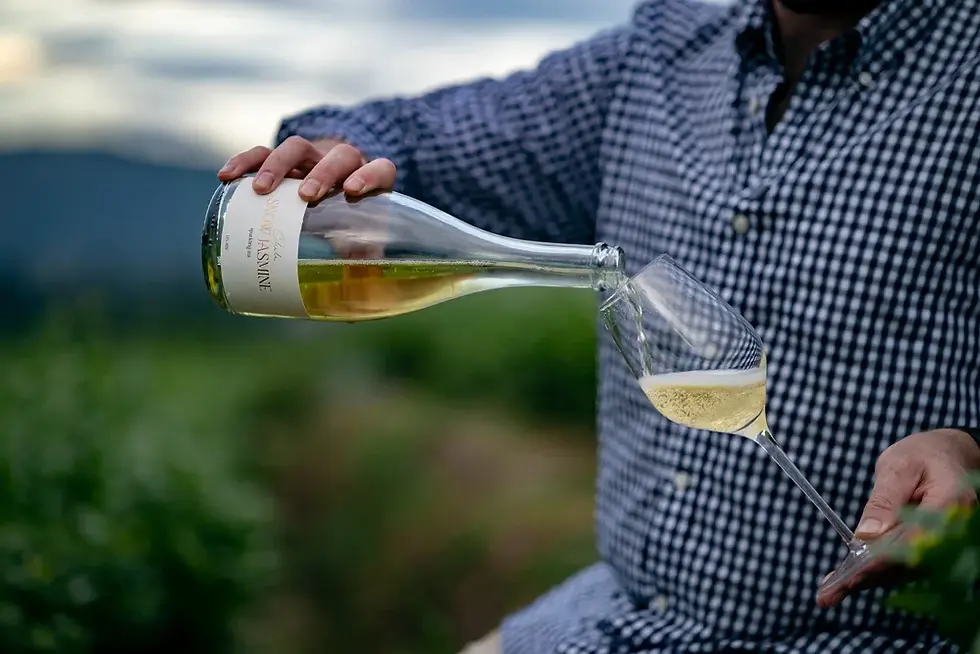
For me, it was about creating elegance. I wanted Chalu to look beautiful in the glass, with a subtle mousse, and I wanted the cork because that pop creates what I call the "Champagne moment."
At the same time, it's a non-alcoholic beverage that needs shelf stability. We pasteurise, but we don't add preservatives because we don't want to cover the tea with anything unnecessary.
Bringing all those technical components together while preserving the elegance of the beverage was probably the hardest part.
6. How do you approach working with local producers and ecosystems in Yunnan?
Fraser:
Tea cultivation in Yunnan goes back millennia, and all the producers we work with are multigenerational family growers and producers. Many of them live right in the middle of their tea fields.
We want to work with people who respect their craft and who recognise that the land gives back if you protect it.
Some of our producers belong to ethnic minority communities, including the Bulang people of Lincang. Their ancestors have been cultivating Pu'er for centuries.
There's an enormous amount to learn from them.
Personally, I love simply spending time walking through the hillside tea gardens with the producers, listening to them and soaking everything in. That relationship with the producer and the place is fundamental because ultimately the quality and character of Chalu begin there.
7. Your drinks sit at the intersection of tea, wine, and craft — how do you define Chalu as a category?
Fraser:
There are certainly similarities with wine. Tea has cultivar, terroir, altitude, climate, soil, harvest and processing. Small differences in where and how a tea grows can completely change its flavour profile.
But I don't think Chalu needs to imitate wine. What we're trying to do is give tea the space to express that same level of complexity in a different format.
The tea itself is doing about 90% of the work. That's why choosing a great tea is absolutely fundamental and why we put so much effort into sourcing and R&D.
The oak is almost like seasoning. It's there to bring out particular highlights within the tea and add a layer of tannin that helps define the finesse of the final structure. Then the grape contributes body and drinkability.
We take a lot of care to present Chalu Sparkling Tea as a bottle that can sit comfortably on a dining table next to the finest sparkling wines, appealing to a wide audience and a wide range of occasions.
But it all starts and ends with the tea itself.
8. What is your vision of tea within the no/low alcohol (NOLO) movement?
Fraser:
It's a very interesting moment.
A lot of people are focusing on NOLO right now, including some very large beverage companies. But I think it's important to approach the category holistically and not become too caught up in the hype.
At its core, NOLO exists because people either can't drink alcohol or don't want to drink alcohol. We need to focus on that and create genuinely good alternatives rather than producing something non-alcoholic simply for the sake of entering the category.
If somebody isn't drinking, they should still have something elegant and full of flavour. It shouldn't just be a cheap juice or soda in attractive packaging.
That's where tea becomes incredibly interesting.
Tea naturally gives us a structure we can work with. A really high-quality tea, treated with respect and used intentionally, can create something sophisticated enough to sit comfortably within the premium NOLO space.
But I also don't think it needs to become overly exclusive. Tea is a very inclusive beverage. There is room for highly gastronomic sparkling teas, but also for more everyday tea-based products with interesting flavour profiles.
Tea is naturally suited to both.
9. How do you balance complexity, structure, and drinkability when designing a sparkling tea?
Fraser:
Again, the tea is doing about 90% of this by itself. That's why tea selection is the absolute key.
The oak works almost like seasoning, highlighting the finer elements of the tea and introducing another layer of tannin to define the structure. The grape is there for body and drinkability.
Then carbonation becomes another structural element. It has to be precise enough to give freshness and elegance without overwhelming the aromatics of the tea.
Ultimately, we want something complex enough to be interesting at the dining table but also immediately enjoyable.
We want Chalu to feel special when you open the bottle, pour it into a glass and experience that mousse and aroma — but we don't want complexity to become a barrier to drinking it.
10. Looking ahead, how do you see Chalu evolving — both in terms of products and its place in global beverage culture?
Fraser:
Even since our meeting in Brussels, we've already added several new markets, expanded the Chalu production line here at our factory and started a new partnership with ASC, one of China's largest wine distributors.
The size and scope of the audience for Chalu is growing quickly.
That's amazing for us because it gives us the opportunity to put Chalu — and, more importantly, a taste of Yunnan — in front of more people.
There is such strong interest in non-alcoholic beverages right now, alongside rapidly growing interest in sparkling tea. It's an incredible moment to introduce more of Yunnan's finest teas to the world.
We're also expanding the way people can experience Chalu. We're launching new formats, including 250 ml bottles, and beginning R&D into potential limited-edition SKUs.
Ultimately, I hope Chalu can contribute to the development of both the non-alcoholic beverage industry and sparkling tea as a category, in China and globally.
But at the centre of that growth, we want to keep doing what we started to do: sharing a taste of Yunnan with the world.


Comments