
Holding Tea, Holding Energy: In conversation with Taiwanese ceramic artist Evon Wang

Updated: Jul 31

Introduction
When I first discovered Evon Wang's work, I was immediately struck by something difficult to describe. Her tea bowls and teapots were unmistakably contemporary, yet they carried a quiet sense of familiarity—as if they had always existed. Their rounded forms, soft colours and subtle textures felt less like objects to admire than companions waiting to become part of someone's daily tea practice.
During my recent journey through Taiwan, I had the pleasure of visiting Evon in her studio. Surrounded by sculptures, sketches, tea bowls and works in progress, we spent the afternoon discussing far more than ceramics. Our conversation naturally wandered through Japanese philosophy, Taiwanese tea culture, sculpture, museums, Picasso, Giacometti, the beauty of old Roman walls, and the invisible energy that handmade objects can carry.
Originally trained as a designer before pursuing a Master's degree in ceramics at Tama Art University in Tokyo, Evon has built a distinctive artistic language that bridges contemporary sculpture with functional teaware. Her pieces are collected internationally and exhibited across Asia, yet they remain deeply rooted in everyday tea practice. For her, a tea bowl is never merely a vessel—it is an object that quietly shapes the atmosphere of a space and the emotions of the person holding it.
In this conversation, Evon reflects on how tea transformed her approach to ceramics, why she believes objects possess their own energy, how the Japanese tea ceremony reshaped her creative process, and why embracing uncertainty has become one of the most rewarding aspects of working with clay.
The result is an intimate conversation about craftsmanship, presence, and the quiet dialogue between the maker, the object and the person who eventually welcomes it into their hands.
Part 1 — Beginnings in ceramics, Japan, tea, and form
Lorela: Could you start by telling me how you began working with ceramics?
Evon Wang: I started ceramics during my free time while I was working, and then I decided I wanted to do it long-term. I first met an artist in Taichung, WU Wei-Cheng. The first time I saw his work, it felt very modern, almost architectural — very different from traditional teaware in Taiwan.
Because I wanted to make more and learn the process, I started working in his studio. I was around 22 or 23 at that time. It was the first time I realised ceramics could be a career. At first, you imagine it only as a hobby, but I saw him raising a family through this profession, so I decided I wanted to make it my career too.
Then I decided to go to Japan for a master’s degree to study ceramics specifically. I went to Japan in 2014 and studied at Tama Art University. I had studied design before, but I wanted to enter an art university for more philosophical thinking and training.
In Japan, there are three well-known ceramics universities in Tokyo. One is more traditional art, one is more design and craft, and our school was more focused on sculpture and abstraction. That was the area I was most attracted to.
During school, we didn’t do much practical work. Our teachers’ works were often very large, unique sculptures, and we talked a lot about philosophy, culture, and universal art. But we also experimented a lot with clay and glaze — how to present different textures and different displays.
I learned a lot during that time.
Thanks to these two influences, I combined these two areas: I liked drinking tea, and I made teaware during my free time, while for school projects I made sculptures.
Lorela: Why did you choose Japan rather than South Korea? South Korea also has a strong ceramic tradition, especially moon jars.
Evon Wang: That’s true. South Korean ceramics are very impressive, especially moon jars. But decades ago, when I started looking for books about tea and ceramics in Taiwan, the good books were written in Japanese. At first, I wanted to learn Japanese, so I could understand those books. Then I started thinking that maybe I could also go to Japan.
Taiwanese people are very close to Japanese culture. In terms of tea drinking and the tea ceremony, I also really respect Japanese culture. At that time, I wasn’t very interested in Korean culture, so I chose Japan first.
Lorela: I think Korean ceramics and tea culture are becoming much more visible now, especially in Seoul, with tea bars, tea festivals, and younger makers creating more innovative teaware.
Evon Wang: Yes, it feels like a boom in the last three years. Many of my friends go to Korea several times a year now. They’ve discovered young Korean artists making teaware, and it’s quite impressive. I also went to Seoul once to see the stores and tea places. But for the tea itself, I feel it is not quite there yet.
Lorela: Yes, I tend to agree. There is a lot of green tea, some yellow tea, some black tea, but it still feels like they are rebuilding or rediscovering that mastery.
Evon Wang: Yes. For me, Taiwan is very unique in terms of tea and teaware. When I started making my kind of teaware, I wanted a tea set that was very close to my own style. I also wanted to learn tea more deeply, and I wanted to use wares that connected with me.
Lorela: Your work feels more feminine, and also more suited to smaller hands. That seems important — that the object is in line with the person brewing the tea.
Evon Wang: Yes. I don’t only make pink or cute things now. I think I have settled down a lot. But ten years ago, I made things that were very pink, cute, and vivid. Now, after ten years of learning tea, I’ve started to settle down. I think classic pieces can be used at any time. But when I see young Korean artists, I feel their work is fun and energetic.
In April, I had a small exhibition in Taichung. The owner is around the same age as me, and we talked about bringing more fun characters into the process — maybe a very cute tea set you can bring to a picnic.
Lorela: Is it important for you that the pieces you create are aligned with the spirit you want to convey? For example, white pieces may feel more classic and timeless, like a little black dress, while bolder pieces may be more occasional.
Evon Wang: Yes. Also, I don’t really like making sets. I prefer that people combine different pieces — maybe vintage pieces, maybe fun designs. Every piece in your house can become part of a tea set.
For my clients, especially beginners, I usually suggest they don’t buy a whole set at once. Maybe they buy one piece a month, because your taste changes during the learning process. You can combine different wares for different occasions, and that is very fun for me too.
Lorela: Was there one exceptional piece that distinguished your work and moved it more into an artistic scene rather than purely functional teaware?
Evon Wang: I tried to combine my sculpture work with functional objects. I made works like that around ten years ago. The shapes and techniques came from my sculpture work.
For functional pieces, a teapot has certain shapes that are more useful. But for a chawan, I think it can be more playful — different shapes, different colours. I once made a large-scale chawan where you could put a big ice cube inside and make iced tea during a party. Sometimes I draw paintings inside, so you can see it as an artwork, but you can also use it on the tea table.
Lorela: I love the roundness of your shapes. They feel less conventional.
Evon Wang: Thank you.
Lorela: How did you arrive at those rounded forms? Were there influences from sculpture, European art, Asian art, or ancient art?
Evon Wang: I think everything influences me. I really like going to museums and exhibitions. For one piece, the drawing was inspired by Picasso. I had one of his sketchbooks, and the drawing was from ancient Greek vases. Picasso had drawn the patterns of ancient vases in his own way.
I had a collaboration with a restaurant, and the theme of the dining season was Picasso. They made his artworks into cuisine, and I made one of the plates for the meal.
Picasso also made ceramic work. There is one work where he used egg, bacon, and a fork — all made in clay. The chef wanted to create a dish with egg and bacon, and he asked me to make a plate with a fake fork.
At first, he only asked me to produce the plate, but I wanted to do something different. I wanted to put my own learning from Picasso into the work. There were twelve people at the dining table, and on each fork I carved a different name — the names of Picasso’s twelve lovers. When people received the cuisine, they would ask, “Who am I?” and “Who are you?” and that started a conversation.
When you Google those women, you find that one was a photographer, one was a ceramist. Picasso started making ceramics because of one of these women. So I wanted this to be the start of a conversation. People might think the thing is about Picasso, but the foundation is the people in his life.
Lorela: How do you balance what a client wants with your own style?
Evon Wang: Clay is a very eternal material, so I try to hide my memories or something inspiring from that period of my life inside the work. I try to balance it so it doesn’t become too much like a lecture — just a little bit.
You can see it simply as a pretty thing. But if you want to understand more, I can tell you more stories about each piece. That feels comfortable for me, for the work, and also for the people using it.
For me, the most important thing is to enjoy the process of making. Once it becomes the work, it is already satisfying to me. What people think about my work is secondary; however, if they want to know more, I can always tell them more.
Lorela: So the creation process is what you enjoy most?
Evon Wang: Yes.
Lorela: Did you begin with teaware or sculpture?
Evon Wang: Before I went to Japan, I made teaware because of the studio where I stayed. Every morning when I entered the studio, the artist would always be sitting at his table making tea. I would drink tea with him. We didn’t talk a lot — maybe just, “Oh, it’s hot today” — and then we would start doing what we wanted to do that day.
So for me, tea became a very natural companion in life during that time. The artist told me that if I wanted to make ceramics my career, I should start learning tea ceremony.
Actually, my mother had suggested that before, because she had learned tea ceremony too. But in Taiwan there are too many styles and teachers, and I didn’t really like her style. I’m not a person who likes strict rules.
When I went to Japan, I started learning Japanese tea ceremony — Urasenke. It changed a lot for me. It is very traditional, especially matcha, with a tradition of more than 400 years. I started to realise the good things in that strictness.
For me, the tea room is like an unrealistic thing inside real life. When you enter the tea room, you have to follow the rules, but within that training there is also freedom. You can enter another world.
I don’t have classes right now, but sometimes I still practise by myself. It is lifelong learning. It feels a little like Buddhism.
Lorela: For me, I prefer a less codified way of drinking tea — a simple gaiwan, teapot, and bowl, drinking tea with music or while doing other things. The beauty of tea is that there are so many ways to experience it, and it becomes personal.
Evon Wang: Yes. When I was in Japan studying sculpture, I still remember the first project. Before school started, during the summer, our homework was to take many photographs of textures in our life — at least 30 or 40 pictures. We had to make them into a folder and write why each texture attracted us. So we created a database of the textures we were interested in. Then we tried to recreate or translate them into ceramic work. It was a very good practice.
Lorela: Texture is so important. A photograph can suggest texture, but you don’t truly know until you touch it.
Evon Wang: Yes, especially when you hold something. The weight is very important to me. When I shop for teaware, I always have to hold it and feel it. Sometimes two pieces have almost the same shape, but the thickness is different, and that changes everything.
This links my functional work and sculpture. It is about what I am trying to let you feel. For example, if I want you to feel subtle warmth when holding a tea bowl, I choose a certain clay and glaze.
Part 2 — Objects, energy, exhibitions, tea masters, and daily tea
Evon Wang: I like buying objects. For me, objects have the energy of life. This is important in Eastern culture, I think — in Japan and Taiwan too. We feel that things can have some power inside. I want to make works where people can feel that energy when they interact with them.
Lorela: I understand. In Western culture, we often don’t give objects the same value. I admire Japanese culture because things are made to last. In the West, consumption is very fast.
Evon Wang: Yes. And the object changes back to you.
Lorela: Beautiful objects can shape the energy of a space. When I enter your space, even if there are many objects, it does not feel overwhelming. There is harmony.
Evon Wang: So I try my best to keep my own energy before making them. In this apartment, I spend a lot of time alone. Before I start making teapots, I might spend two weeks making cups and doing a very repetitive or even boring process to prepare myself for the stage where I can make teapots.
Lorela: You practise tea every day, right?
Evon Wang: I drink tea every day. Sometimes I just drink it. But sometimes, if I feel anxious and need to calm down, I make it more slowly so I can bring myself more peace.

Lorela: Were there artists, apart from the artist you trained with, who influenced your style?
Evon Wang: Many. Different tea masters have different ways of making tea, and that inspired me to make different shapes.
For example, a cup shape is connected to a totally different way of making tea. If I hadn’t met that teacher, I wouldn’t have made this shape. For him, it was important not to use a certain type of vessel, and instead to use this shape to preserve the tea flavour. Before that, I made small teapots and small teacups. After learning tea from him, I started making this kind of shape.

Lorela: So tea masters influence the way you create cups or teapots?
Evon Wang: They influence the way I make tea. Then tea influences my shapes.
Lorela: What is your favourite tea?
Evon Wang: I don’t have one favourite tea. I choose tea by emotion, feeling, or season. I enjoy white tea in my daily life. In Taiwan, people say aged white tea becomes medicine — like Chinese medicine. It changes flavour over time, and for me that process is very interesting.
For other teas, I choose depending on the weather, mood, or season. But white tea is something you can drink throughout the year.
Lorela: What I like about white tea is its delicacy and clarity. It can feel floral, but not completely floral. It is difficult to pinpoint.
Evon Wang: Yes. They don’t put too much craft into it. That is the most interesting part. The process is simple, so it shows what the earth and environment bring to the tea. It is very honest. There are also bad white teas, because there is no craft to cover things up.
Lorela: Are you planning to come to Europe for an exhibition? Have you already exhibited in Europe?
Evon Wang: Not yet, actually. I am really looking forward to that opportunity. A few years ago, I started going to Europe for residencies. Mainly, I made sculptures from objects. In Paris, I had a workshop for a tea ceremony, but not an exhibition.
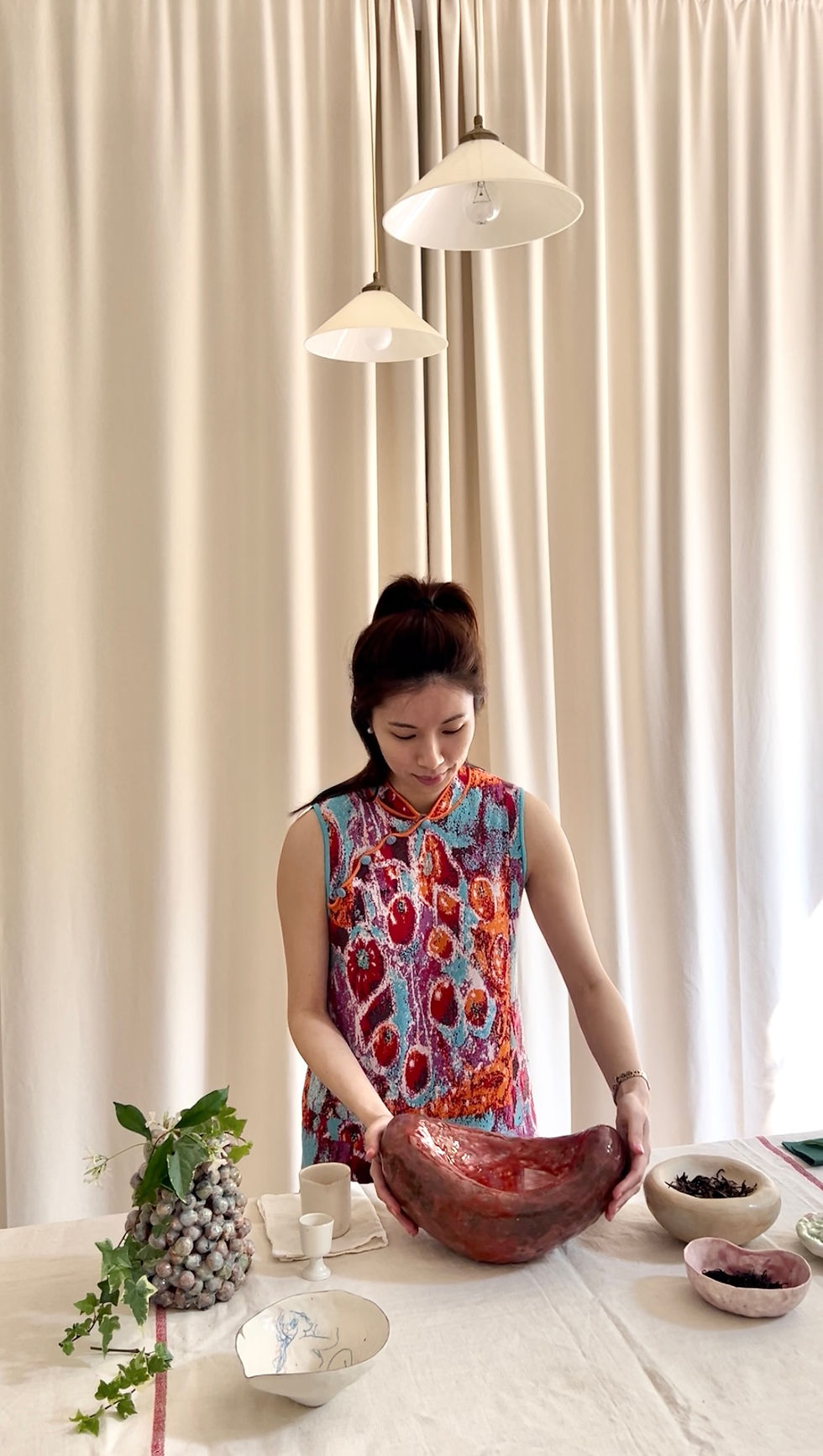
Lorela: What type of oolong are we drinking now?
Evon Wang: This is a black oolong. I remember it has a very specific peach flavour. It is very organic. I’m not sure about the cultivar. I only remember the place where I bought it — a store in Taipei.
Lorela: I’ve already bought so much tea in Taipei. Tea and ceramics are dangerous — you never finish collecting.
Evon Wang: It is a lifetime collection.
Lorela: Are you planning to make matcha objects too?
Evon Wang: Yes. I just made this small natsume two days ago. It was my first time making one myself. I’m planning to make matcha sets — maybe big or small.
Lorela: It’s so cute. There’s no pink.
Evon Wang: Yes, no pink. But after I made it, I thought maybe I need to learn how to make it pink too.
Part 3 — Materials, glazes, firing, sculpture, and galleries
Lorela: We haven’t discussed much about the types of glazes, clay, and firing techniques you use. What do you generally prefer?
Evon Wang: I use matte glaze. Actually, I don’t have many different glazes. Most of the glazes are the same, but I change the clay body underneath, and that creates different textures.
I don’t have a big studio, so for glazing I only have maybe four or five different glazes. But for clay, I mix many different kinds. Sometimes I mix different clays with coloured slip to create the surface.
For example, some have no glaze outside, but I put colour into the slip, which creates different texture. During the process of making a teapot, I shave a lot of clay, and I use that to make the slip. Different clays make different slips.
Lorela: And this piece — is it painted?
Evon Wang: This one was fired many times. The first time, the bottom was originally red, but I wasn’t satisfied with the result, so I put a different slip outside and fired it again. Because it had already been fired, the slip started to break down and became more fragile.
It is almost like an old building, where the walls keep falling. I like that texture, especially in Italy, like in Rome. I like the walls there. Every time I go, I take pictures of the walls. They show different layers in different light. You can feel there are many layers inside.
Usually, ceramics are fired twice: biscuit firing and glaze firing. But with gold, it is overglaze, so I have to fire once more. All of my work is fired at least three times.
Lorela: Is it electric firing?
Evon Wang: Yes. It’s safer. Sometimes I also put saggar firing inside the kiln. I make a big box and put the piece inside with leaves, pepper, fruit peels, or other organic material. I can put it into the electric kiln and create a reduction-like effect, which brings different textures.
Sometimes, if I’m not satisfied with the colour, I put another layer and fire it again, and wait for the surprise. For last year’s exhibition, I made pieces that look like wood firing, but I did them in my own kiln. It wasn’t glaze. I put a lot of red pepper inside the saggar firing. Inside, you can see natural ash effects. I also sometimes preserve materials, like a small Christmas decoration, and save it for firing so it can create natural glazing.
Lorela: Does it hurt when a piece breaks, especially after so much work?
Evon Wang: Yes. There are many works I make as experiments, but sometimes the result won’t be shown in an exhibition. I save them for the next try.
Lorela: Some of the designs look as though they were made with string.
Evon Wang: This one I drew with a glaze pencil. But for another one, I used string with glaze.
Lorela: Are there sculptors who have influenced your style?
Evon Wang: Yes. I like Alberto Giacometti. I made a little Giacometti-like figure for myself using clay, so it is very fragile. It broke once.
I also like many different African sculptures. And I really like Taro Okamoto. At first, his style was not what I liked, because it felt very masculine to me when I was younger. But when I visited his work in person, I was very moved.
When I first saw one of the faces, the original face was in another building, and it was very large. I cried because it was so powerful to see it in person.
He took many photographs of rituals and tribal things in different areas of Japan — Okinawa, the far northeast. In the past, those areas were not simply “Japanese”; they had their own cultures. I think he found the original energy of human beings. After that, he could accomplish many things in his work.
Lorela: I notice you also collect work by other artists.
Evon Wang: Yes. This painting was a birthday gift I gave to myself. It was made by an artist in Bangkok. She is young, maybe around 30 or 32. I like her style because it feels free, and she enjoys her creation.
For me, making functional ware can sometimes create boundaries. Sculpture is a totally different mindset. That painting reminds me to be more creative and freer when I make things. If I drew that kind of painting myself, I wouldn’t have the courage to make it so messy, or to combine pink with black. So I brought it into my space as a reminder.
Lorela: You also make fountains?
Evon Wang: Yes. I started making fountains last year, and now some of my fountain works are exhibited in a gallery. This new fountain is about this size, and you can put a coin in it to make a wish. You can place it inside your home as a small fountain.

Lorela: How is your collaboration with galleries? Many artists say that even when they exhibit in galleries, it is difficult to make a living.
Evon Wang: It’s not easy, especially for sculpture. I think Taiwanese collectors, and maybe collectors worldwide, often prefer painting. Ceramic sculpture is harder to sell because it is heavy, breakable, and you need space to collect it. I understand that it is harder for galleries.
For me, making functional ware is the way to support myself. It supports my time and freedom to make more playful or sculptural works.
Lorela: With ceramics, there is also the frustration that you never fully control the result.
Evon Wang: Yes. That is important in ceramics. I have to step back — for tea and for firing — because it is half and half. I don’t control everything, and I like that.
In the beginning, it can be frustrating. But during my time in Japan, when we made sculptures, I understood that there isn’t one correct answer. The teacher wouldn’t say, “You have to do this.” Instead, they would ask, “How close is this piece to your imagination?”
So it is not simply success or failure. I remember one work collapsed during firing. I was shocked, because I had made a certain shape and it collapsed into something completely different. But the teachers loved it. They said it had power — that you could feel the firing and gravity.
At first, I displayed it in the way I had imagined, but the teachers took it and looked at it from different perspectives, maybe even wall-hanging. I started to realise it was another world. It didn’t matter what I had thought at first. The work could transform into something that was not my design.
Lorela: Are you coming to Europe this year for any shows?
Evon Wang: I’m not planning anything yet, but if there is an opportunity, that would be great.
For Lisbon, I first went there on a one-week trip by myself during Lisbon Design Week, when many studios were open for visits. I met the founders of Studio Mirante, and we talked about a tea ceremony. The two French co-founders said they wanted to try it but didn’t have access, so I made tea for them. They welcomed me to come back. We became friends, and I went to their studio twice later — once last year and once three years ago.


Comments